Rocks are naturally occurring materials that are composed of a mixture of minerals (normally).
There are three main classifications for rocks; igneous, sedimentary and metamorphic.
Igneous Rocks
Igneous means from magma and there are two types of igneous rocks; extrusive (volcanic) and intrusive (below surface). Extrusive rocks cool quickly because the magma is thrown on to the ground or into the ocean resulting in small mineral crystals. Intrusive rocks cool slowly because the magma is in the earth’s crust resulting in larger mineral grains as seen in granite.
Extrusive (Volcanic) Igneous Rocks
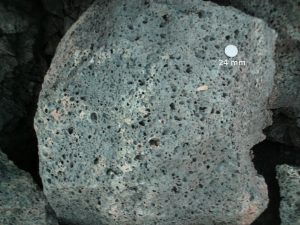
Basalt is the most common rock and new basalt is forming continuously from volcanoes all over the earth. Basalt usually contains gas pockets that are sometimes later filled with agate such as those found at Monte Lake.
Vesicular Basalt. Photo by Jstuby via Wikimedia Commons. Public domain
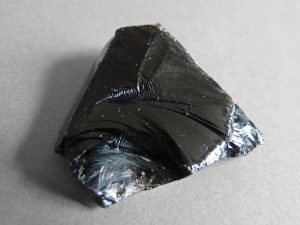
Obsidian is volcanic glass formed by very rapid cooling which prevents any crystal growth. Obsidian is commonly black but can be various colours and tectures. Obsidian is high in silica and has concoidal fracture.
Obsidian. Photo by Ji-Elle via Wikimedia Commons, licensed under CC BY SA-3.0
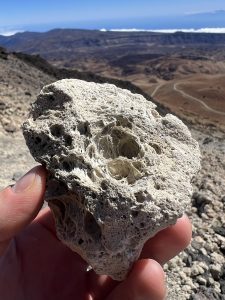
Pumice is a light weight and light coloured volanic rock that can float on water.
Pumice. Photo by A11w1ss3nd via Wikimedia Commons, licensed under CC BY-SA 4.0
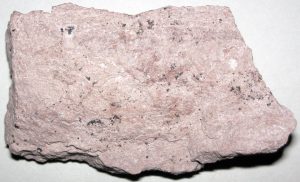
Rhyolite is a light coloured felsic rock containing silica and feldspar. Rhyolite often contains gas pockets that can contain topaz (Topaz Mountain, Utah), garnet (Garnet Hill, Nevada), and other minerals.
Rhyolite. Photo by James St. John via Wikimedia Commons, licensed under CCA 2.0
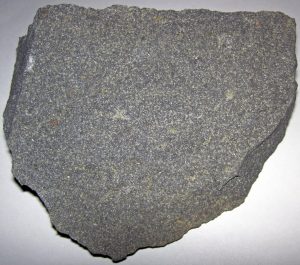
Andesite is the name of a family of fine-grained, extrusive igneous rocks that are usually light to dark gray in color. They have a mineral composition that is intermediate between granite and basalt. Andesite is a rock typically found in volcanoes above convergent plate boundaries between continental and oceanic plates.
Andesite. Photo by James St. John via Wikimedia Commons, licensed under CCA 2.0
Click on the link below for more information from geology.com
Intrusive igneous rocks are coarse grained rocks resulting from the slow cooling of magma within the earth’s crust. Magma can intrude and shape the crust in various distinct formations:
Batholiths: Massive, irregular bodies of magma that coalesce deep underground, often forming the cores of major mountain ranges.
Stocks: Smaller, irregular bodies similar to batholiths but with less than 100 square kilometers of surface exposure.
Dikes: Discordant sheets of magma that cut vertically or diagonally across existing rock layers.
Sills: Concordant sheets of magma that squeeze horizontally between layers of older sedimentary rocks.
Intrusive rocks are generally classified based on their silica and mineral content:
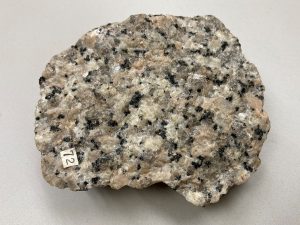
Granite: A felsic rock rich in quartz and feldspar, known for its light color. It is highly durable and commonly used in construction and monuments.
Granite. Photo by B. Domangue via Wikimedia Commons, licensed under CC BY-SA 4.0
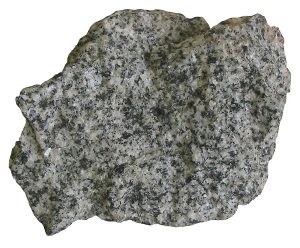
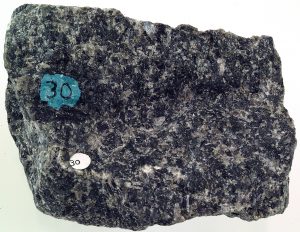
Diorite: An intermediate rock with a distinct “salt-and-pepper” appearance due to roughly equal mixtures of light and dark minerals.
Diorite. Photo by Siim Sepp via Wikimedia Commons, licensed under CC BY-SA 3.0
Gabbro: A dark, mafic rock (the intrusive equivalent to basalt) primarily composed of calcium-rich plagioclase and pyroxene.
Gabbro. Photo by Darla Sondrol via Wikimedia Commons, licensed under CCO 1.0 Universal Public Domain Dedication
Sedimentary Rocks
Sedimentary rocks are formed by the accumulation of sediments. There are three basic types of sedimentary rocks.
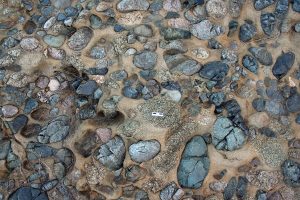
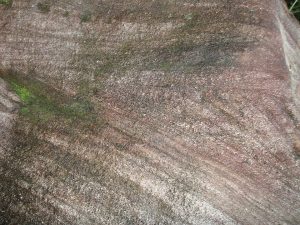
Clastic sedimentary rocks form from the accumulation and lithification of mechanical weathering debris. Examples include: breccia, conglomerate, sandstone, siltstone, and shale.
Conglomerate. Photo by Michael C. Rygel via Wikimedia Commons, licensed by CC BY-SA 3.0
Sandstone. Photo by Yendor of Yinn, via Wikimedia Commons, licensed under CC BY-SA 3.0
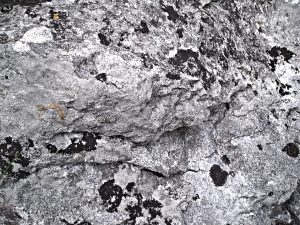
Chemical sedimentary rocks form when dissolved materials preciptate from solution.
Examples include: chert, some dolomites, flint, iron ore, limestones, and rock salt.
Limestone. Photo by Stephen Burton, via Wikimedia Commons, licensed under CC BY-SA 2.0
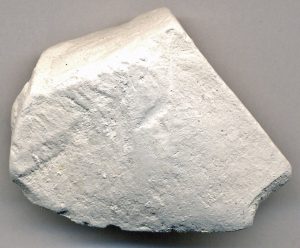
Organic sedimentary rocks form from the accumulation of plant or animal debris. Examples include: chalk, coal, diatomite, some dolomites, and some limestones.
Chalk. Photo by James St. John, via Wikimedia Commons, licensed under CCA 2.0
Metamorphic Rocks
Metamorphic rocks have been modified by heat, pressure, and chemical processes, usually while buried deep below Earth’s surface. Exposure to these extreme conditions has altered the mineralogy, texture, and chemical composition of the rocks.
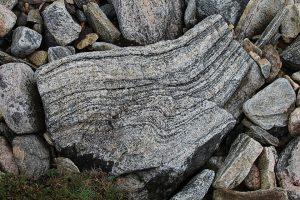
There are two basic types of metamorphic rocks. Foliated metamorphic rocks have a layered or banded appearance that is produced by exposure to heat and directed pressure. Examples of foliated rocks include: gneiss, phyllite, schist, and slate
Gneiss. Photo by GerritR, via Wikimedia Commons, licensed under CC BY-SA 4.0
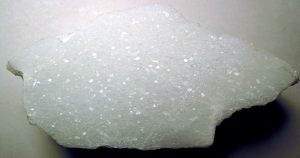
Non-foliated metamorphic rocks do not have a layered or banded appearance. Examples of nonfoliated rocks include: hornfels, marble, novaculite, quartzite, and skarn.
Marble. Photo by James St. John, via Wikimedia Commons, licensed under CCA 2.0
Summary
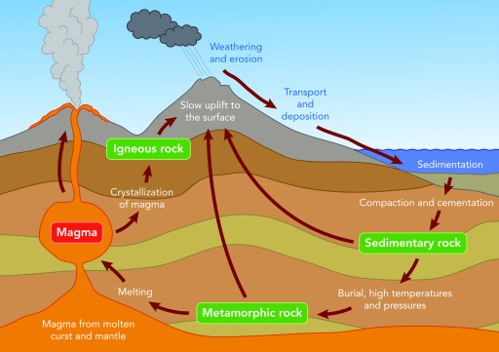
Image Credit: 3.5 The Rock Cycle – Physical Geography and Natural Disasters. Salt Lake Community College. CC 2.0 by generic deed